A tree rarely gives much warning before it becomes a serious problem. One season it is casting shade across the garden, and the next it is leaning towards a roof, dropping heavy limbs, or cracking after a storm. That is where a proper guide to safe tree felling matters – not as a rough idea of where to start, but as a clear reminder that felling a tree is skilled, high-risk work that depends on planning, judgement, and the right equipment.
For homeowners and site managers alike, the biggest mistake is assuming tree felling is simply a matter of cutting at the base and stepping back. In reality, every tree has its own weight distribution, structural condition, surrounding hazards, and access limitations. A straight, healthy stem in an open field is one thing. A mature tree overhanging a drive, greenhouse, road, outbuilding, fence, or neighbouring property is something else entirely.
What makes tree felling dangerous
Tree felling goes wrong when people underestimate forces they cannot fully see. Internal decay, dead wood, storm damage, twisted grain, a heavy side lean, wet ground, and strong winds can all change how a tree behaves once the cut starts. Even a smaller tree can kick back, split vertically, barber-chair, or drop branches unexpectedly.
There is also the working environment to consider. Overhead lines, restricted gardens, public footpaths, nearby roads, sheds, parked vehicles, and uneven ground all increase the margin for error. If climbing is required, or if the tree needs to be dismantled in sections rather than felled in one piece, the risk rises sharply.
This is why safe tree work is not just about cutting technique. It is about controlling the whole site so that nothing is left to chance.
Guide to safe tree felling – start with assessment
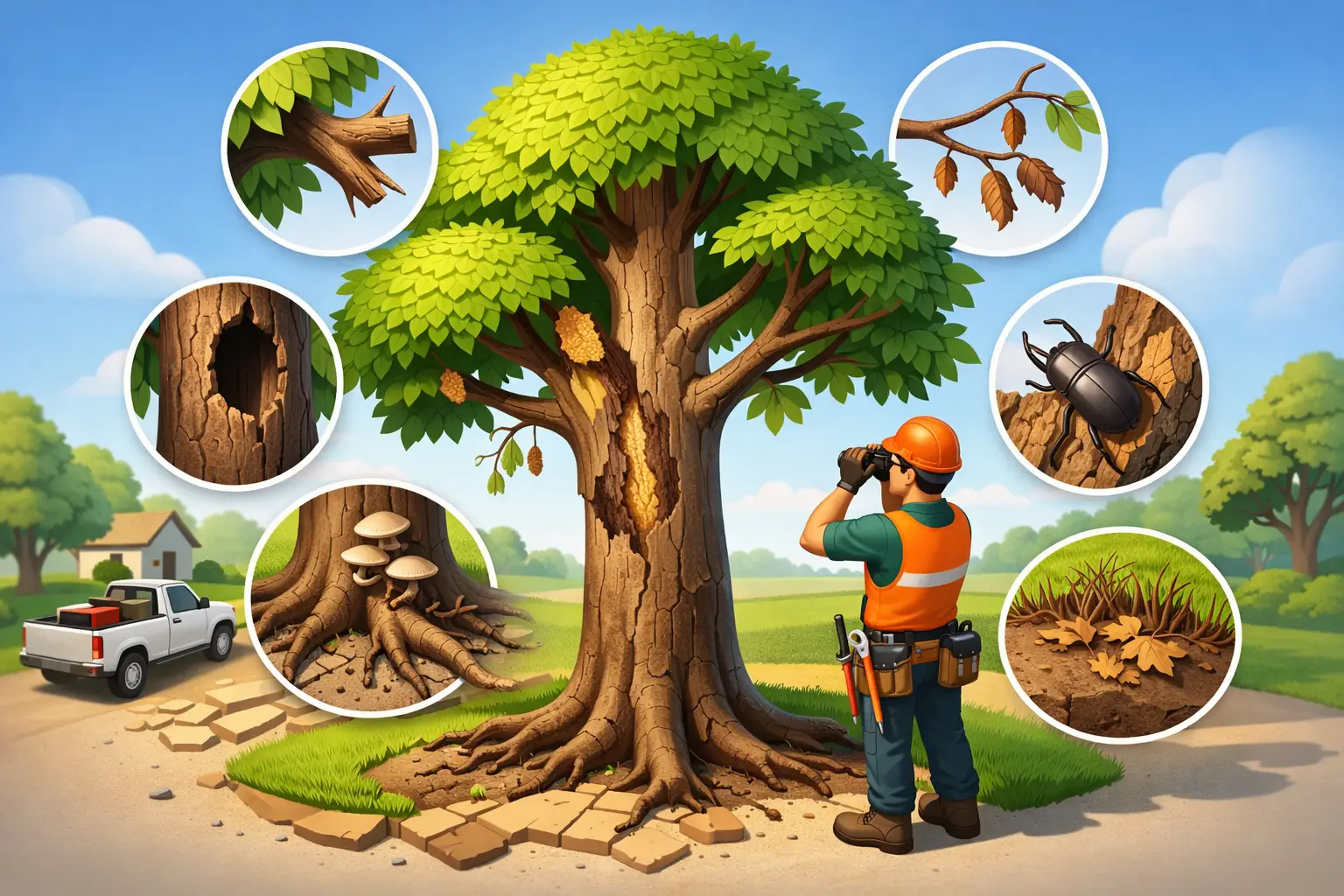
Before any saw is started, the tree and its surroundings need to be assessed properly. That means looking at the species, the height, the diameter, the natural lean, crown weight, visible defects, root condition, and likely direction of fall. You also need to identify what could be struck if the plan goes wrong.
The ground conditions matter more than many people expect. Soft, boggy, sloped, or unstable ground can affect footing and escape routes. Wind direction can also make a straightforward job unsafe very quickly. If conditions are poor, stopping and rescheduling is often the right call.
There are legal and practical checks too. Some trees may be protected, and work near highways, boundaries, or public areas may need extra controls in place. On managed sites and commercial land, a clear method statement and risk assessment are often essential. On domestic jobs, the principle is exactly the same even if the paperwork is simpler – know the risks before the first cut.
Planning the fell
A safe fell starts with a defined drop zone and at least one clear escape route, ideally set back at roughly 45 degrees from the expected direction of fall. The work area should be kept clear of anyone not directly involved. If there is any possibility of the public entering the area, proper barriers and supervision are needed.
The chosen method depends on the tree and the space available. In a large open area, a straight fell may be possible. In tighter spaces, sectional dismantling is usually the safer option, with branches and stem sections lowered in a controlled way. That takes trained climbers, rigging knowledge, and suitable equipment.
This is one of the biggest trade-offs in tree work. A full fell can be quicker and cheaper where space allows, but dismantling is often the safer and more precise choice when the surroundings are tight. The right option depends on the site, not just the budget.
Equipment plays a major part in safe tree felling
A proper guide to safe tree felling also has to be honest about equipment. Personal protective equipment is basic but essential – chainsaw protective trousers, suitable boots, helmet, eye protection, gloves, and hearing protection are standard. Beyond that, the tools need to match the job.
A saw that is poorly maintained, incorrectly sized, or used without experience adds risk immediately. Felling levers, wedges, ropes, rigging gear, climbing equipment, communication methods, and access machinery may all be required depending on the tree. On awkward jobs, specialist access such as a cherry picker can make the work safer and more controlled.
Good equipment does not make an unsafe operator safe. It simply supports good practice. Experience is what tells you when to fell from the ground, when to climb, when to dismantle, and when to stop because the conditions are no longer acceptable.
Why cutting technique matters
The hinge is what controls the tree for as long as control is possible. The directional notch and back cut need to be accurate, proportionate to the tree, and suited to the species and condition of the stem. If the cuts are poorly placed, the tree may twist, split, fall off line, or go early.
That is why trained arborists do not treat every tree the same. A straight conifer can behave differently from a broadleaf with an uneven crown. A decayed ash can react differently from a sound beech. Dead, storm-damaged, or hung-up trees require even more caution because normal holding wood may not behave as expected.
This is not a case of sharing step-by-step cutting instructions for the general public. For anyone without training and practical experience, the safer message is simple: technique is critical, and getting it wrong can cause serious injury or major property damage in seconds.
When not to fell a tree yourself
There are situations where DIY tree felling should be ruled out straight away. If the tree is large, close to buildings, near roads or power lines, storm-damaged, partly uprooted, dead, leaning heavily, or difficult to access, professional help is the right answer.
The same applies if the tree needs climbing, rigging, traffic management, or sectional dismantling. These are not add-on complications. They are clear signs that the work requires trained operatives and specialist equipment.
Across residential and commercial sites, the jobs that look manageable from the ground are often the ones with the most hidden risk. A tree can appear stable and still contain decay, split under tension, or fail unpredictably once cut. That is where experienced local teams earn their keep – by spotting the issues early and carrying out the work safely, cleanly, and with a proper plan.
The value of professional tree felling
Professional tree felling is about more than getting the tree down. It is about protecting people, buildings, neighbouring land, and the wider site from avoidable damage. A competent team will assess the tree properly, select the safest method, use the right access equipment, control the drop zone, and tidy the site afterwards.
That last part matters. Good tree work should not leave a property looking like a storm has passed through. Customers want safe removal, sensible advice, and a clean finish. Whether the job is a single garden tree or a wider site clearance, the standard should be the same.
For clients in places like Fife, Dundee, and Perth, weather can also be a factor. High winds, saturated ground, and storm damage are common reasons for urgent tree work. In those cases, a fast response helps, but rushing never replaces safe working methods.
After the tree is down
Felling is only part of the job. Once the tree is on the ground, the site still needs to be made safe. Branches are processed, timber is cut and removed or stacked as agreed, and the stump is either left, reduced, or ground out depending on the client’s plans for the area.
Sometimes retaining the stump is fine in a rural setting. In a garden, driveway edge, lawn, or development plot, stump grinding is often the better option because it removes the trip hazard and makes the space usable again. It depends on what comes next for the site.
A good contractor will also advise if nearby trees should be inspected, especially where storm damage, disease, or crowding has been a factor. One removal can reveal wider issues that are worth dealing with before they become urgent.
Choosing the right help
If you need a tree removed, ask direct questions. Is the team insured? Are they trained for chainsaw and climbing work? Do they have the right equipment for restricted access or high-risk trees? Will they assess the site properly and leave it tidy afterwards?
Clear answers matter. So does local knowledge. A contractor who regularly works across mixed residential streets, estates, rural properties, and commercial sites understands the practical realities of access, weather exposure, and customer expectations. HL Tree Services works with exactly that approach – safe methods, honest advice, and a high standard of finish on every job.
The safest decision is often made before any cutting begins. If there is any doubt about the tree, the site, or your ability to control the risks, stop there and get expert advice. Tree felling should never be a gamble, especially when a careful plan can keep people safe and the job under control from start to finish.