A branch across the lawn can look like a straightforward garden tidy-up. But if it has fallen from height, is under tension, has brought down cables or is still caught in the canopy, it can quickly become a serious safety issue. Knowing how to deal with fallen branches starts with resisting the urge to drag, cut or climb before you have checked what is holding the branch in place.
For homeowners, estates and site managers, the right response depends on the size of the branch, where it has landed and whether the tree itself has been damaged. A small, cleanly broken twig is one thing. A heavy limb resting on a roof, fence, vehicle or public path needs a far more careful approach.
Make the area safe before moving anything
Your first job is to keep people away. Children, pets, visitors and staff should be kept clear until you know the branch is stable. A fallen limb can roll, spring back or shift unexpectedly, particularly after high winds or heavy rain when the ground is soft.
If the branch has landed near a road, driveway or footpath, make the hazard visible from a safe distance. Do not stand in the road or attempt to direct traffic unless it is safe and appropriate to do so. For a branch obstructing a public highway or creating an immediate danger, contact the relevant authority or emergency service as required.
Be especially cautious if you see overhead power, telecoms or street-light cables. Treat every cable as live. Keep well clear, do not touch the branch or anything it is resting on, and report the issue to the network operator. Tree work around utilities is specialist work and should never be attempted with domestic tools.
Check whether the branch is truly down
A branch on the ground is not always fully detached. It may be hung up in surrounding limbs, caught on a shed roof or held under pressure by another branch. This is known as a hung-up branch, and it is one of the most unpredictable situations in garden tree work.
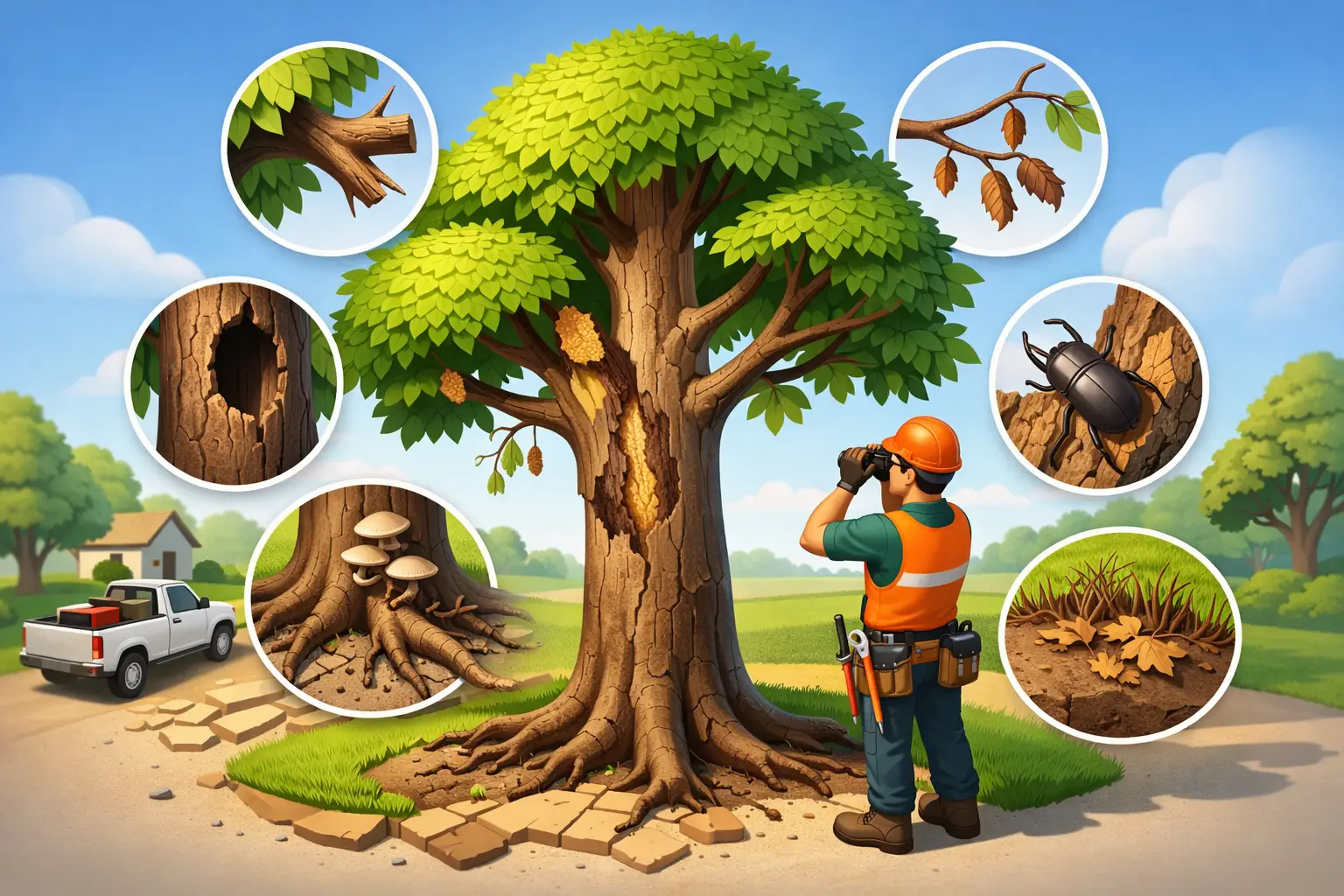
Look from a safe position for snapped wood still attached to the trunk, torn bark, split limbs or a branch suspended above head height. Do not stand beneath it to inspect it more closely. A partially detached limb can fall without warning, especially when wind picks up again.
Also look at the tree as a whole. A large branch failure may indicate decay, a weak union between two stems, storm damage or an imbalance in the crown. If there are fresh cracks in the trunk, roots lifting from the ground, or a noticeable lean that was not there before, treat it as urgent. Clearing the fallen wood alone will not solve the underlying risk.
When a small branch can be handled at home
There are occasions when clearing a fallen branch is a reasonable domestic task. This is usually limited to small, fully detached material lying flat on open ground, well away from cables, buildings and other trees. Even then, wear sturdy footwear, gloves and eye protection, as splintered wood and thorny growth can cause injuries.
Move branches in manageable sections rather than trying to drag a long, awkward limb in one go. If you are using hand tools, keep cuts low-risk and only work on wood that is stable on the ground. Avoid using a chainsaw unless you are trained, equipped and confident in its safe use. Chainsaw injuries often happen during seemingly simple clean-up work, when a branch rolls, binds the saw or releases tension.
Smaller prunings can be cut down for green waste collection, stored for habitat piles where suitable, or chipped for mulch. Do not pile material against fences, sheds or the base of a living tree. It can trap moisture, attract pests and make future maintenance harder.
Do not cut branches under tension
When a branch has landed across another object, the wood can be under compression, tension or both. Cutting in the wrong place may cause the branch to whip, pinch the saw or jump suddenly. The forces involved can be substantial even in timber that does not look particularly large.
This risk is common where a branch is resting across a fence, lodged on a hedge, leaning against a building or lying on uneven ground. It is also common after storms, when several branches have become tangled together. If you cannot clearly see how the weight is being supported, leave it alone.
Professional arborists assess the direction of pressure, the weight distribution and the safest order for dismantling the branch. Where access is restricted or the limb is still elevated, specialist rigging equipment or a cherry picker may be needed. That is not overkill – it is the controlled way to prevent further damage and avoid injury.
Protect buildings, fences and vehicles
If a branch is touching a roof, conservatory, fence or parked vehicle, avoid pulling it away. The action that removes the branch can cause more harm than the impact itself, especially if the timber is snagged on guttering, tiles or glass.
Take clear photographs from a safe position before any work begins. This can help with insurance records and gives a tree professional a better idea of the situation when arranging a visit. If water is entering a property, use a bucket or temporary internal protection where safe to do so, but do not climb onto a damaged roof.
For commercial premises, make sure the incident is recorded and the affected area is isolated. A fallen branch in a car park, school grounds, communal garden or access route can create a liability risk as well as a practical obstruction. Prompt professional clearance helps return the site to safe use with minimal disruption.
How to deal with fallen branches after a storm
Storm conditions can leave hazards that are not immediately obvious. Even once the wind has dropped, damaged branches may continue to fall over the following hours or days. Do a visual check from ground level, but do not walk beneath overhanging limbs to inspect the canopy.
Pay attention to mature trees, particularly those with dense crowns, multiple stems or previous pruning wounds. Conifers can shed substantial limbs in high winds, while broadleaf trees may suffer split branches where weight and wind have overloaded a weak junction. Saturated soil can also affect root stability, making a tree more likely to lean or fail.
Where there is immediate danger to people, property or access, an emergency tree service is the right call. A qualified team can make the area safe, remove unstable timber in sections and assess whether further pruning, bracing, felling or a tree survey is required. The priority is not simply getting the debris removed. It is preventing the next branch from coming down.
Consider the health of the remaining tree
A broken branch leaves a wound, but it does not always mean the tree needs major work. Trees can compartmentalise small wounds naturally, particularly where the break is clean and the tree is otherwise healthy. However, torn bark, long vertical splits and large wounds at the trunk need professional assessment.
Avoid painting over wounds or making an oversized cut in an attempt to tidy the break. Poor cutting can remove the branch collar, slow recovery and create a larger entry point for decay. An arborist can make a correct pruning cut where appropriate and advise whether the crown needs reducing or rebalancing.
This is also a good time to consider preventative maintenance. Selective pruning can remove deadwood, reduce end weight on vulnerable limbs and improve clearance from roofs, paths and neighbouring boundaries. It should be planned around the species, condition and natural shape of the tree, rather than carried out as a harsh cut-back.
Choose professional help for heavy or awkward clearance
Call a professional if the branch is large, elevated, tangled, near cables, resting on a structure or connected to a damaged tree. The same applies if you need a path, driveway or commercial site reopened quickly. A competent tree team will arrive with the right equipment, carry out a risk assessment and leave the area clean once the work is complete.
At HL Tree Services, we regularly deal with storm-damaged and awkward fallen branches across Fife and the surrounding area. Safe dismantling, careful protection of nearby property and thorough site clearance are all part of the job, not optional extras.
A fallen branch may be a one-off result of rough weather, or it may be the first visible sign that a tree needs attention. Giving it a careful assessment now can protect your property, keep people safe and help the tree remain a valued part of the landscape for years to come.