A tree can look solid from the drive and still be one strong gust away from dropping a heavy limb. That is why knowing how to spot dangerous trees matters, especially if you have mature trees near a house, road, fence, driveway or public footpath. In our part of Scotland, wet ground, strong winds and repeated storms can turn a hidden weakness into a real hazard very quickly.
Most tree defects do not announce themselves dramatically. They show up in small changes – a fresh crack in the stem, bark lifting away, a lean that was not there before, or branches dying back in one section of the crown. Some of these signs point to decline, some point to instability, and some mean the tree needs urgent professional attention.
How to spot dangerous trees from the ground
A sensible first check starts at ground level and works up. You do not need specialist equipment to notice the early warning signs, but you do need to look carefully and stay realistic about what you can assess safely.
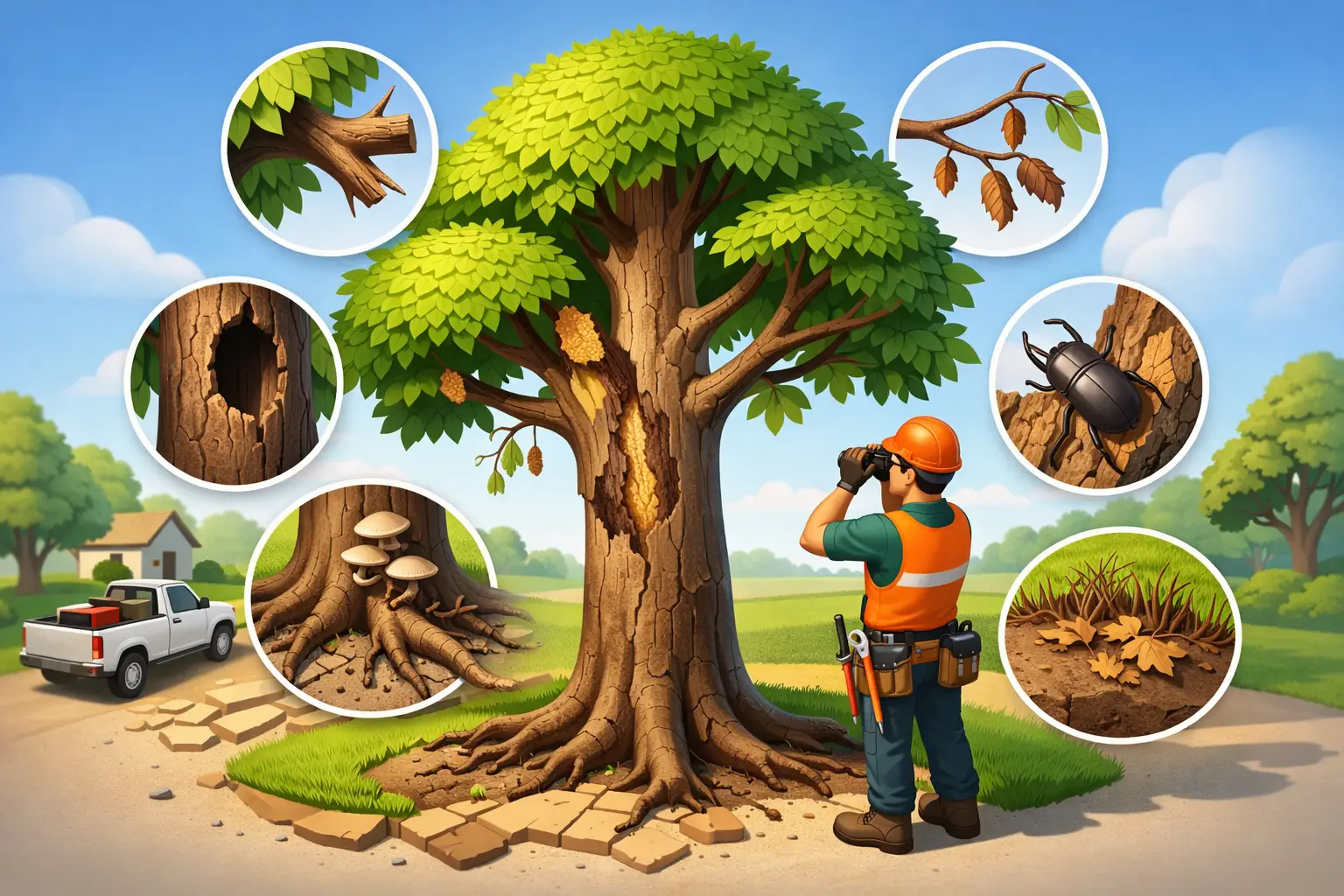
Start at the base of the tree. If the soil is lifting, cracked or mounded on one side, that can suggest root movement. This is especially concerning after heavy rain or strong wind, when saturated ground gives roots less support. Fungal growth around the base can also be a warning sign. Not every mushroom means a tree is dangerous, but brackets or clusters growing from the trunk flare or nearby roots often point to decay within the root system or lower stem.
Then look at the trunk itself. Deep splits, long vertical cracks, cavities, hollow sections, and bark falling away can all indicate structural weakness. A tree can survive with a cavity for years, but it depends on the size, position and extent of sound wood left around it. That is where experience matters. A small cavity in one species may be manageable, while a similar defect in another tree, close to a target such as a conservatory or parked cars, may present a much higher risk.
Move your eyes upward into the crown. Dead branches, sparse leaf cover in season, unusually small leaves, or one side of the canopy thinning more than the other are common signs of stress or decline. If a large limb is hanging, split, or rubbing hard against another, it may fail without much warning. Any branch suspended over a road, play area, neighbour’s garden or building deserves closer attention.
The clearest warning signs of a dangerous tree
Some signs suggest monitoring. Others justify making a call straight away. The more of these you see together, the less time you should waste.
A sudden lean is one of the biggest concerns. Plenty of trees grow naturally at an angle and remain stable for decades. What matters is change. If a tree has recently shifted, if the ground around it is disturbed, or if roots are starting to lift, it needs urgent assessment.
Cracks and splits are another major warning sign, particularly where the trunk forks into two main stems. Included bark – where bark is trapped between those stems instead of forming a strong union – can create a weak point. In windy weather, that junction is often where failure begins.
Deadwood is also easy to underestimate. Small dead twigs are common. Large dead limbs are not something to ignore. They become brittle, heavy and unpredictable, and they can fall long before the rest of the tree declines.
Fungal fruiting bodies deserve caution as well. Some fungi are relatively harmless surface colonisers, but others are linked to serious decay. If you notice fungi appearing on the stem base, exposed roots or main trunk, it is worth having the tree checked properly rather than guessing.
Storm damage and weather stress
High winds do not always bring a tree down immediately. Sometimes they weaken it first. A branch tears but stays attached, the root plate shifts slightly, or an old crack opens further. After a storm, the obvious damage is only part of the picture.
If you are checking trees after rough weather, keep your distance. Look for hanging branches, snapped tops, fresh splits, exposed roots and any new lean. Listen as well. A creaking trunk or branches moving independently from the rest of the canopy can point to a structural issue.
In exposed areas across Fife, Dundee and Perthshire, wind loading can be severe, particularly on trees that have recently become more exposed after neighbouring trees were removed. A tree that stood fine in a sheltered group may struggle alone. That does not always mean removal is needed, but it does mean the tree may need pruning, support or a closer inspection.
Tree species, age and location all matter
There is no single rule that fits every tree. Species, age, soil conditions and surroundings all affect risk. Fast-growing trees can become brittle with age. Older trees may have significant habitat and landscape value, but they are more likely to contain deadwood, cavities or decay pockets. Trees in compacted ground, near construction, or in narrow lawns beside driveways often face extra stress below the surface.
Location changes the level of urgency too. A decaying tree at the far end of a field is not the same as a decaying tree overhanging a house, school entrance or car park. Arborists look at both condition and target. In simple terms, a tree becomes far more dangerous when there is something valuable or busy within falling distance.
That is why good advice is rarely about alarmism. It is about proportion. Some trees need monitoring over time. Some need remedial pruning. Some need urgent dismantling before they fail.
Signs that call for professional assessment
If you can see a major crack, active decay, root movement, a fresh lean, large dead branches or storm damage near a property, do not try to deal with it yourself. Climbing ladders, cutting suspect limbs, or working beneath a compromised tree is exactly how people get hurt.
A professional arborist can assess structural defects more accurately, identify likely decay issues, and judge whether the tree can be retained safely. In some cases, the answer may be targeted pruning to reduce load on a weak limb. In others, felling is the responsible option. There is no benefit in keeping a tree standing if it puts people or property at risk.
This is also where practical access matters. Awkward trees over garages, roads, greenhouses and commercial sites often need specialist equipment and controlled dismantling rather than simple cutting. That is the difference between a quick job and a safe one.
What not to rely on
A healthy-looking canopy does not guarantee a safe tree. Likewise, a tree in poor health is not automatically dangerous today. Hidden decay can sit behind green leaves, and some declining trees remain structurally stable for a long time. The trouble is that without experience, it is hard to know which is which.
It is also a mistake to assume that because a tree survived the last storm, it will survive the next one. Defects tend to worsen, not improve. Once water gets into cracks, decay advances, or the root plate has shifted, the margin for error gets smaller.
And while online photos can be useful for comparison, they are no substitute for a proper site visit. Trees are three-dimensional structures, and risk depends on details that are easy to miss from one angle.
A sensible checking routine for homeowners and site managers
You do not need to inspect trees obsessively, but you should make a habit of looking at them a few times a year and after major weather events. Late winter is useful because the branch structure is easier to see. Spring and summer help you spot poor leafing, dieback and dead sections. After storms, focus on sudden changes.
Walk around the tree if access allows. Compare it with how it looked before. Ask simple questions. Has it started leaning? Is the canopy thinner on one side? Are there fresh cracks, peeling bark, fungus at the base, or dead branches over a target area? If the answer is yes, treat that as a reason to get advice rather than wait and hope.
For larger properties, commercial grounds, estates and shared spaces, periodic professional surveys are often the best route. They help catch issues early, support duty of care, and reduce the chance of emergency work later on.
HL Tree Services regularly speaks to customers who thought a tree was probably fine because it still had leaves on it. Once inspected properly, the fault was in the stem or roots, not the foliage. That is a common situation, and it is why caution pays.
A tree does not need to look dramatic to be dangerous. If something appears different, unstable or out of place, trust that instinct and have it checked. It is far better to act on a warning sign early than wait for the weather to make the decision for you.