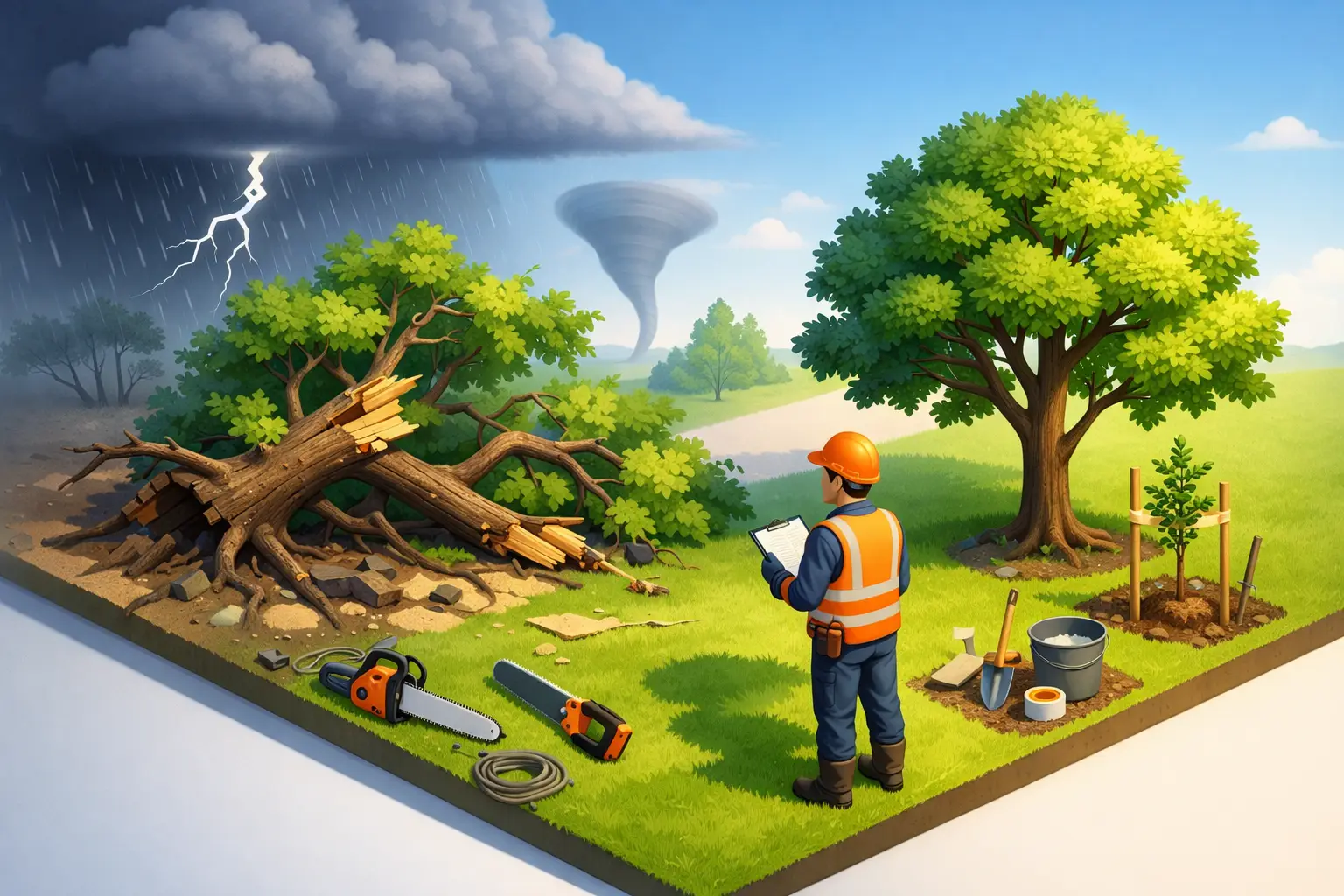
A tree can look beyond saving the morning after a storm – split limbs on the lawn, bark torn away, a lean that was not there before. The question homeowners usually ask first is simple: can storm damaged trees be saved? Sometimes yes. Sometimes no. The right answer depends on the species, the age of the tree, the extent of the damage, and just as importantly, whether it is still structurally safe.
That is why the first step is never to start cutting at random. Storm damage can leave trees unstable, partially suspended, or under tension in ways that are not obvious from the ground. What looks like a loose branch can still be holding weight. What seems like a minor lean can point to root failure. In many cases, quick action helps, but the wrong action makes matters worse.
Can storm damaged trees be saved after high winds?
High winds do not affect every tree in the same way. A healthy, well-established tree may lose a limb and recover well with proper pruning. Another may suffer a split stem or root plate movement and never regain safe structure. The main issue is not whether the tree is still alive today, but whether it can recover into a stable, healthy tree over time.
If the damage is limited to smaller branches, the canopy can often be rebalanced and cleaned up. If a major limb has failed but the main trunk is sound, there is still a fair chance of retention. If the trunk is split, if more than half the crown is lost, or if the tree has begun to lift from the ground, the outlook is much less favourable.
There is also a difference between biological recovery and practical retention. A tree may continue growing after a storm, but if it is left with a permanent structural weakness over a house, road, driveway or public space, keeping it may not be responsible. Saving a tree is only worthwhile if it can be made safe and managed properly.
What damage can be repaired, and what usually cannot?
Some forms of storm damage are relatively straightforward to deal with. Broken secondary branches, torn but localised crown damage, and limited canopy imbalance can often be corrected by careful pruning. The aim is to remove failed material cleanly, reduce stress points, and give the tree the best chance to compartmentalise wounds.
Young trees can sometimes recover surprisingly well, especially if the trunk is intact and the root system has not been disturbed. Their structure is still developing, so formative pruning may help them regain a workable shape over the next few growing seasons.
Other damage is far more serious. A split main stem, severe bark loss around the trunk, or obvious root heave usually means the tree has lost critical stability. Once the anchoring roots have torn or the trunk has fractured, there is rarely a dependable fix. Bracing systems can help in selected cases, but they are not a cure-all and they are not suitable for every species, site or defect.
A mature tree that has lost one large scaffold limb may still be saved. A mature tree that has lost several major limbs on the same side may become too unbalanced to retain safely. This is where experience matters. Tree work after storms is not just about tidying up. It is about judging future risk.
Signs a storm damaged tree may still be salvageable
The best candidates for recovery tend to have damage that is significant but contained. The trunk remains intact, the root plate stays firm, and the loss is confined to part of the crown rather than the whole structure. In those cases, remedial work can often preserve the tree and reduce the chance of further failure.
Good signs include a stable base, no fresh soil lifting around the roots, and wounds that can be cut back to sound wood. It also helps if the tree had a decent form before the storm. A tree with one clear main stem and well-spaced branch structure is usually easier to manage than one that was already weak, overextended, or poorly pruned in the past.
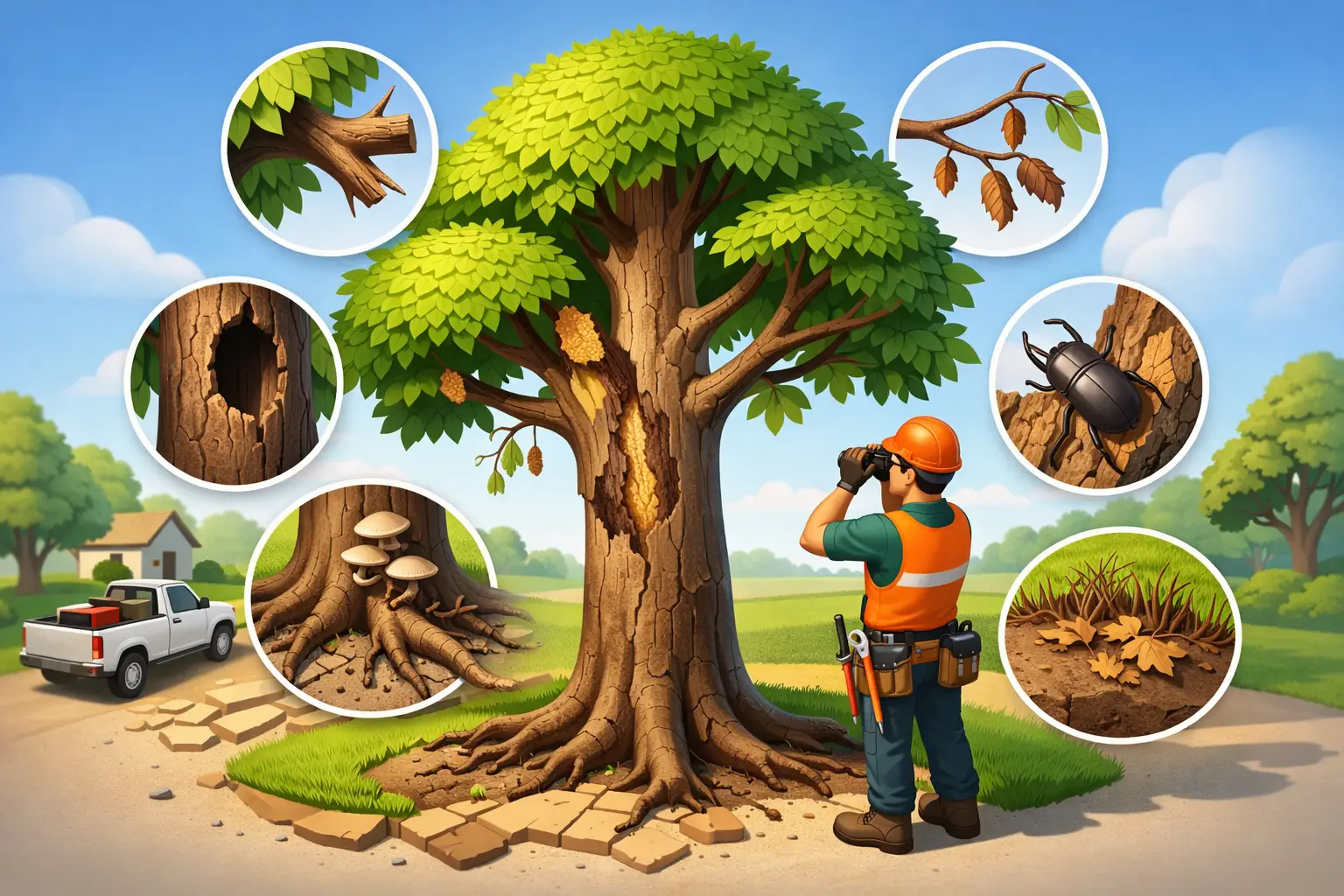
Species matters too. Some trees recover better from hard weather than others. Flexible, vigorous species may put on new growth and respond well after pruning. Older, brittle or decay-prone trees often struggle more. If there was already fungal decay, included bark, dead wood or a history of limb failure before the storm, the damage may simply have exposed a problem that was already there.
When removal is the safer option
There are times when the safest and most sensible route is removal. If the tree is leaning suddenly, if roots are lifting, if the trunk is split through the main union, or if large hanging limbs are left over targets such as parked cars, footpaths or buildings, it should be treated as urgent.
This is especially true after overnight storms, when people head out assuming the worst has passed. A damaged tree does not become safe just because the wind has dropped. In fact, some failures happen hours or days later as fibres continue to tear and saturated ground loosens root hold.
For commercial sites, schools, estates and managed grounds, the threshold for acceptable risk is usually lower. A tree that might be monitored in a private garden may need to be removed if it threatens access routes or public use areas. The same principle applies in tighter residential spaces where there is little room for error.
Where access is awkward, specialist equipment may be needed to dismantle the tree safely. That is often the case with large storm damaged trees near homes, garages, roads or boundary lines. Rushing in with a ladder and a chainsaw is how avoidable accidents happen.
What to do immediately after storm damage
First, keep clear of the tree and the area beneath it. Do not stand under cracked limbs, and do not try to pull down partially broken branches. If the tree is close to overhead services, treat it as a serious hazard and stay well away.
Next, take a proper look from a safe distance. Check whether the tree is leaning, whether the soil is lifting at the base, and whether any major limbs are hanging or resting on structures. Photos can be useful, especially if the situation changes or if you need to explain the issue when arranging professional help.
After that, resist the urge to over-prune. A common mistake is cutting too much too soon in an attempt to “balance” the tree. Poor cuts, unnecessary limb removal and rough topping often reduce the chance of recovery and leave the tree more vulnerable in the long run.
A professional assessment should look at both immediate danger and longer-term viability. In some cases, emergency work is all about making the site safe first, with further pruning or monitoring planned afterwards once the tree has settled.
Can a leaning tree be saved?
A slight lean does not always mean failure. Some trees naturally grow with a lean and remain stable for decades. The problem is a new lean following a storm, particularly if it appears suddenly or is paired with cracking soil, exposed roots or movement at the base.
Young trees that have been pushed over but not fully uprooted can sometimes be reset and supported if dealt with quickly. Mature trees are different. Once a large tree has shifted significantly, the root damage is often too severe for reliable recovery. Even if it remains standing, its future stability may be compromised.
This is one of those situations where false reassurance can be risky. A tree might leaf out in spring and still be unsafe. Survival is not the same as structural soundness.
Why professional pruning makes a difference
Storm-damaged trees need more than a tidy-up. Correct pruning helps reduce further tearing, remove weak attachment points, and shape the crown in a way the tree can cope with. Bad cuts do the opposite. They create larger wounds, encourage poor regrowth, and increase the chance of future failure.
There is also the issue of hidden damage. An experienced arborist will look beyond the obvious breakages and check unions, stem cracks, bark separation, and signs of root instability. That judgement matters if you want to know whether the tree is worth keeping.
For homeowners and site managers across Fife and the surrounding area, that often means making a practical call rather than an emotional one. A valued tree may be retained with careful work. Another may need to come down for safety, with replanting considered afterwards. HL Tree Services regularly deals with both outcomes after severe weather, and the right answer is always based on the tree in front of you, not guesswork.
The best outcome is not always keeping the tree
People often ask whether a damaged tree can be saved because they want to avoid losing something established and important in the garden or landscape. That is understandable. Mature trees add shelter, privacy and character. But keeping a badly damaged tree at any cost is not good tree care.
Sometimes the best decision is to remove a hazardous tree cleanly, protect the surrounding site, and plan for replacement. A young, well-chosen tree planted in the right place can be a far better long-term investment than trying to prolong the life of one that has become unstable.
If your tree has been hit by strong winds, the key is to act early, stay safe, and get a clear assessment before making any cuts. A storm does not always mean the end of a tree, but it does mean the tree needs to be judged properly.