If you have been told you need a survey before building work, buying land, or managing mature trees, the obvious question is what does a tree survey include. The short answer is that it gives you a clear picture of each tree on a site – what it is, what condition it is in, whether it poses a risk, and what should happen next.
A proper tree survey is not just a quick walk-round with a clipboard. It is a structured inspection carried out by someone who understands tree health, structural defects, site use, and the practical realities of tree management. For homeowners, it can prevent guesswork. For developers and commercial site managers, it can help avoid delays, safety issues, and costly mistakes.
What a tree survey is actually for
A tree survey records the condition and significance of trees in a way that is useful for decision-making. That might mean identifying a dangerous limb over a driveway, confirming which trees are worth retaining on a development site, or checking whether work may be restricted by legal protection.
The detail included depends on the purpose of the survey. A survey for mortgage peace of mind is not exactly the same as one for planning. A survey for a school, estate, or commercial premises may put more emphasis on public safety and inspection cycles. The principle is the same, though – it creates an informed record rather than relying on assumptions.
What does a tree survey include in practice?
Most surveys begin with basic tree data. Each tree, or group of trees, is identified by species and location. The surveyor will usually note height, stem diameter, crown spread, and the approximate age class, such as young, semi-mature, early mature, mature, or over-mature. That matters because age and size help shape both management advice and likely life expectancy.
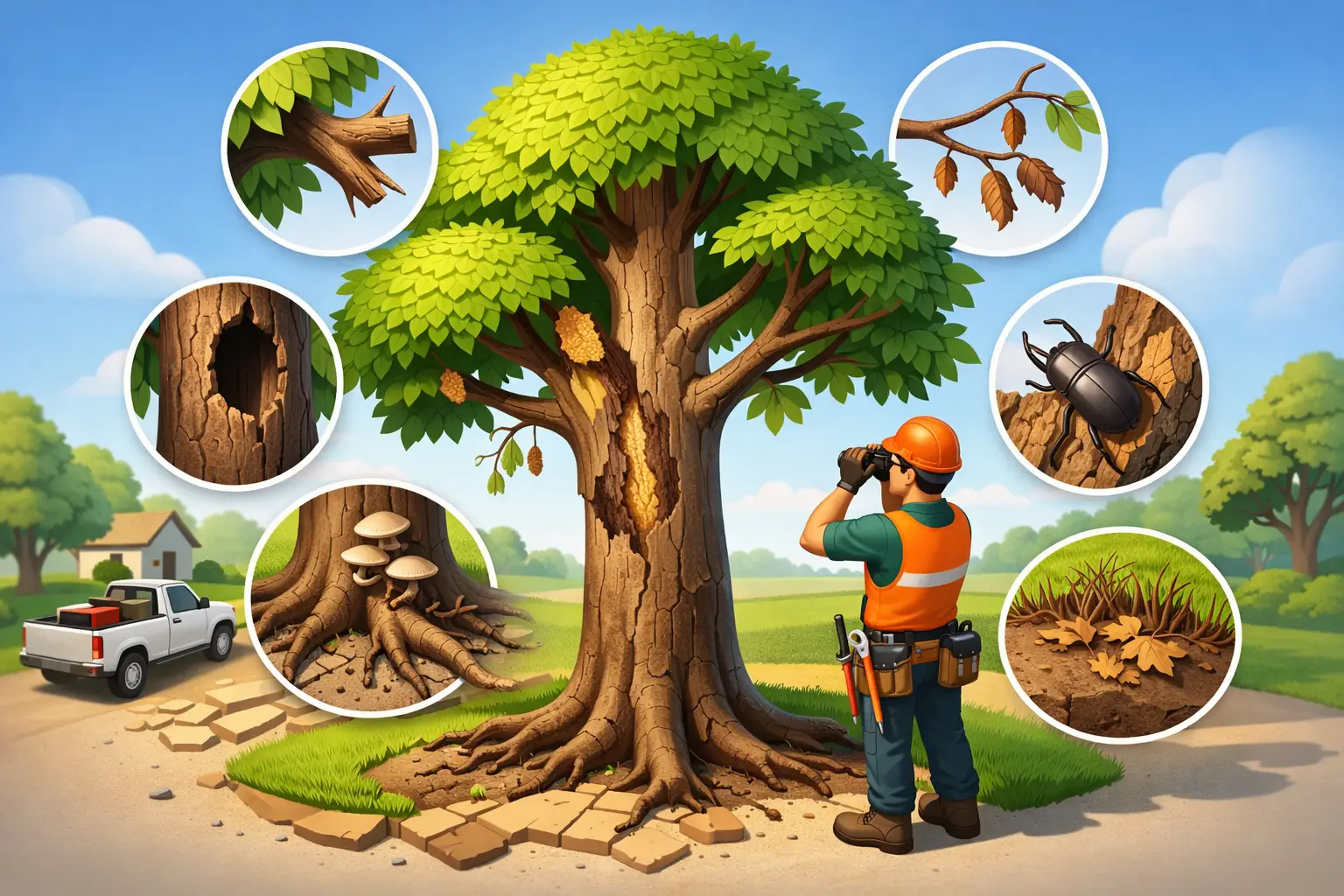
Condition is the next major part. The surveyor looks at the overall health of the tree, including vigour, leaf cover when in season, deadwood, fungal growth, wounds, decay, weak unions, storm damage, and signs of disease or pest activity. They are also assessing structure – not just whether the tree is alive, but whether it is stable and likely to remain safe.
The inspection usually covers the stem, crown and visible root area. Cracks, cavities, included bark, root plate movement, heave in the soil, basal decay, and previous poor pruning can all affect the final assessment. In some cases, a tree appears healthy from a distance but shows structural issues at closer range. That is why professional inspection matters.
Safety and risk assessment
One of the most useful parts of any survey is the risk assessment. This does not mean every imperfect tree is automatically labelled dangerous. Trees are living structures, and many defects can be monitored or managed rather than removed.
What the surveyor is looking at is the combination of defect and target. A tree with a decayed limb in the middle of a field presents a different level of risk from the same tree over a road, car park, public footpath or house. The site use matters just as much as the condition of the tree itself.
This is where experience counts. Good arboricultural advice is not alarmist, but it is also not casual. If a tree needs urgent work, that should be made clear. If it only needs routine pruning, monitoring, or another inspection in a set timeframe, that should be explained plainly too.
Legal constraints and planning issues
Another important part of what a tree survey includes is checking for legal constraints where relevant. Trees may be protected by a Tree Preservation Order, or they may stand within a conservation area. On development sites, there may also be planning considerations that affect what can be removed, retained or worked on.
This can make a major difference to the advice given. A tree may be in poor condition, but protected status can still mean the correct process must be followed before any work is carried out. Equally, a healthy tree may have to be carefully considered in site design because of its amenity value or likely root protection area.
For clients planning an extension, access road, driveway, utility trench or larger build, this is often where survey work becomes particularly valuable. Catching these issues early can save time and avoid problems with applications or site changes later on.
Survey recommendations and next steps
A survey should not just describe trees. It should tell you what to do with that information.
Recommendations may include pruning, crown reduction, deadwood removal, bracing, monitoring, further investigation, or removal where justified. Some trees will simply be marked for retention with no immediate work needed. Others may need periodic review because a defect is present but not yet severe enough to justify major intervention.
Where the survey is linked to development, the recommendations may also cover protection measures. This could include root protection areas, fencing positions, ground protection, no-dig solutions, or guidance on how to work near retained trees without causing avoidable damage. The point is to turn assessment into practical action.
What does a tree survey include for planning applications?
For planning purposes, surveys tend to be more detailed and more structured around site layout. They commonly record tree quality categories, estimated remaining contribution in years, and retention value. They may also identify which trees are unsuitable for retention because of condition, form or conflict with the proposed use of the site.
In many cases, this is paired with a constraints plan showing the effect of canopies and root protection areas on development potential. That helps planners, architects and contractors understand where trees can realistically be kept and what site operations need to avoid.
This kind of work is less about routine maintenance and more about balancing development with sensible tree management. It depends heavily on the site. A back garden extension has different pressures from a commercial clearance project or a housing plot.
How surveys differ from a quote for tree work
People sometimes confuse a survey with a quotation visit. The two can overlap, but they are not the same thing.
A quote for pruning or felling usually focuses on the job requested, access, equipment and cost. A tree survey is broader and more formal. It records findings, gives an assessment of condition and risk, and provides documented recommendations. If there are legal, planning or liability issues, a survey is usually the more appropriate route.
That matters if you are managing a larger site, dealing with insurers, or making decisions that need a professional paper trail. For a single small garden tree, a quote visit may be enough. For anything more sensitive or consequential, a survey is often the safer choice.
When a closer inspection may be needed
Not every issue can be confirmed from a ground-level visual inspection. Sometimes a survey flags the need for further investigation, especially where there are signs of internal decay, hidden defects, or uncertainty around structural stability.
That may involve a more detailed climbing inspection, specialist testing, or a review after weather events. Large mature trees, trees with old pruning wounds, and trees near high-value targets often justify a more cautious approach. It depends on what is visible and what is at stake.
In areas across Fife and nearby towns where mature trees are a valued part of gardens, estates and property boundaries, this is common. A tree can be worth keeping for years to come, but only if it is properly understood and sensibly managed.
What you should expect from the final report
A clear tree survey report should be easy to follow, even if you are not familiar with arboricultural terms. It should identify the trees inspected, explain their condition, note any significant defects or constraints, and set out recommendations in practical language.
If the survey is for planning, the report may be accompanied by schedules and plans. If it is for general management, the format may be simpler, but it should still leave you knowing what needs attention now, what can wait, and what should be monitored.
That clarity is what makes the survey useful. A good report does not bury the key points. It helps you act with confidence, whether that means protecting a healthy tree, arranging safe remedial work, or making sure a site is ready for the next stage.
If you are unsure whether you need a survey or just straightforward tree work, the best starting point is honest advice from an experienced local arborist. The right inspection should leave you with fewer uncertainties, not more.