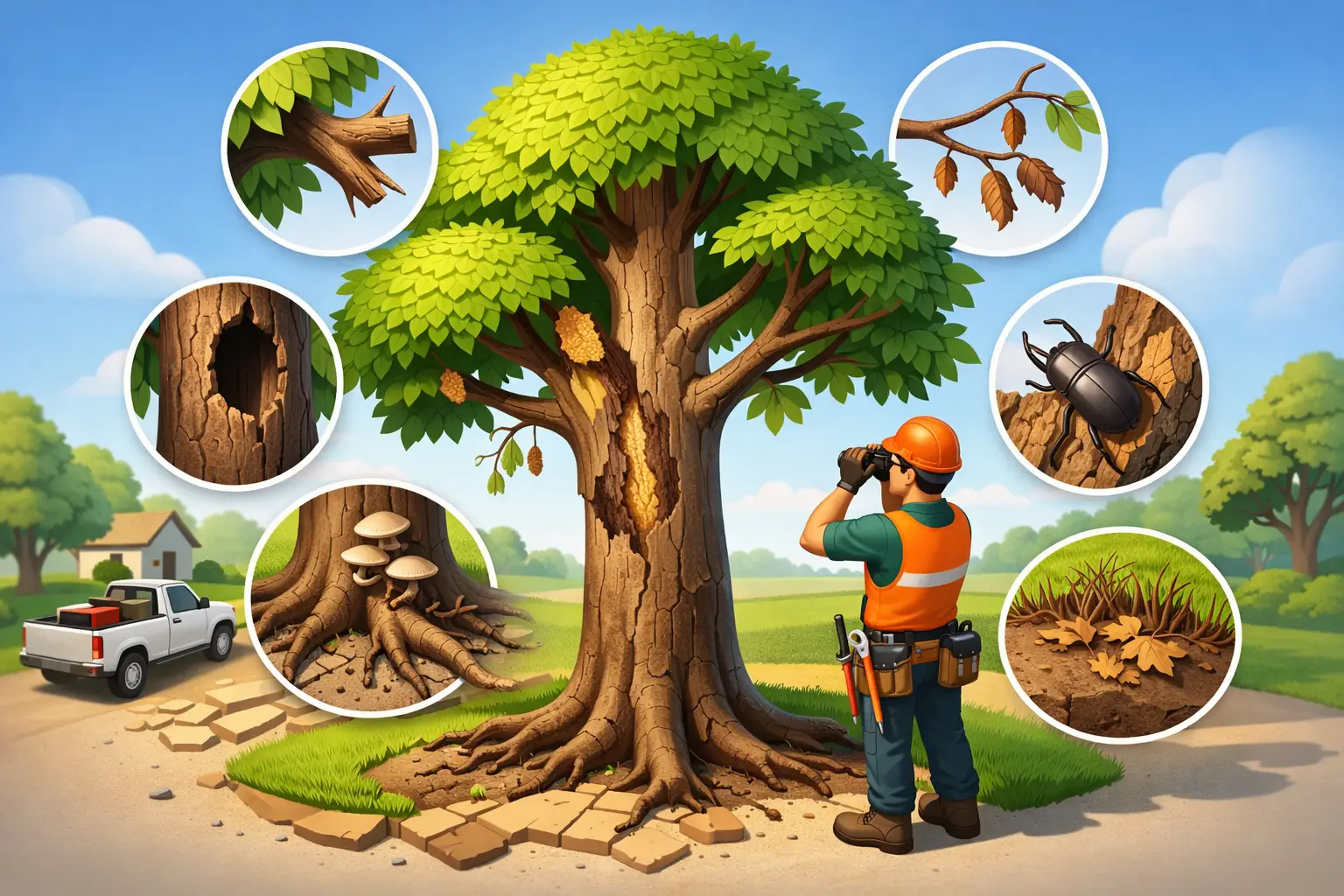
A tree can look fine from the kitchen window and still be heading towards trouble. One split limb after heavy wind, a patch of fungal growth near the base, or a canopy that never properly leafs out in spring can all point to problems that are easier and cheaper to deal with early.
That is why a tree health check for homeowners is worth doing at least once or twice a year. You do not need to be an arborist to spot obvious warning signs. What you do need is a careful look, a bit of common sense, and the confidence to call in professional help when the issue is beyond routine garden maintenance.
Why a regular tree health check matters
Trees add real value to a property. They give structure to a garden, provide shelter and privacy, and often become part of how a home feels. But trees are also living structures with weight, height, and weaknesses that can develop slowly over time.
A neglected issue can become a safety problem, especially if a tree is close to a house, parked cars, footpaths, roads, fences, or neighbouring gardens. In exposed parts of Fife and nearby areas, strong winds and wet ground can quickly turn an existing weakness into storm damage. Catching problems early gives you more options. In some cases, a light prune or crown reduction is enough. Leave it too long and you may be dealing with a major limb failure or full removal.
How to do a tree health check for homeowners
Start at ground level and work upwards. Stand back first so you can see the whole shape of the tree, then move closer to inspect individual areas. If possible, look from more than one angle.
A healthy tree usually has a balanced canopy, expected leaf coverage for the season, and no obvious deadwood or structural defects. That does not mean every uneven branch is a problem. Trees are natural forms, not engineered ones. The aim is not perfection. The aim is to notice change, weakness, or decline.
Check the base and root area
The base of the tree often tells you more than the canopy. Look for fresh cracks in the soil, heaving ground, exposed roots, or a trunk that appears to be lifting on one side. These can suggest root movement or instability.
Also check for fungal bodies around the base. Mushrooms and bracket fungi are not always a reason to panic, but they should never be ignored, particularly on mature trees. Some fungi live on dead material and are relatively harmless, while others can point to internal decay in the roots or lower stem. If the tree is near a target such as a driveway or house, that distinction matters.
Compacted soil, recent building work, raised beds piled against the trunk, or repeated vehicle traffic can also damage root systems. A tree may respond slowly, so stress caused months ago can show up later in the canopy.
Inspect the trunk
Look for splits, cavities, peeling bark, missing strips of bark, and areas that appear sunken or decayed. Included bark at tight branch unions can be a weak point, especially on trees with twin stems.
Sap bleeding, insect holes, or a sudden lean are also worth noting. A lean is not automatically dangerous if it has developed naturally over many years. A new lean, especially after storms or saturated ground, is more concerning and should be assessed properly.
Look closely at the canopy
Dead branches are one of the clearest signs that a tree needs attention. Smaller dead twigs in the upper canopy can be part of normal ageing, but larger dead limbs, bare sections, or branches that have failed to produce leaves while the rest of the tree is in growth suggest stress or decline.
Leaf size and colour also matter. Sparse foliage, unusually small leaves, early leaf drop, or discolouration can point to drought stress, root damage, disease, or nutrient imbalance. That said, symptoms often overlap. A tree with pale leaves may be struggling below ground, while one with thinning foliage may simply be in poor soil. Diagnosis is where experience counts.
If branches are crossing and rubbing, that can create wounds over time. If the crown is heavily weighted to one side, overextended, or sitting close to a roof or overhead lines, the issue may be more about management than health, but it still deserves attention.
What is normal and what is not
Homeowners sometimes worry about features that are perfectly typical, and miss the ones that matter. A few lichens on bark are usually harmless. Moss on branches is common in damp conditions. Some trees naturally carry dead inner wood as the canopy matures.
What raises concern is change. If a tree that has always looked full suddenly starts thinning, if bark begins to split, or if limbs start shedding more often than usual, something may be going on. Comparing this year’s growth to previous years is often more useful than comparing one species to another.
Season also matters. Deciduous trees should not be judged the same way in January as in June. Evergreens can drop older needles naturally. Flowering and fruiting can vary from year to year. A good check takes timing into account.
Common warning signs homeowners should not ignore
Some issues justify a prompt call to a tree surgeon rather than a wait-and-see approach. Large dead branches, visible decay cavities, fungal growth at the base, major cracks, storm damage, hanging limbs, and sudden leaning all fall into that category.
Pests and diseases can be harder to identify without training, but obvious symptoms such as blackened leaves out of season, repeated dieback, or bark lesions are worth investigating. If the tree is protected, in a conservation area, or close to a public space, proper advice becomes even more important before any work is carried out.
When a DIY check is enough and when it is not
A simple visual inspection is useful for routine monitoring. It helps you notice changes, plan maintenance, and avoid the common mistake of leaving a problem until it becomes urgent.
What it cannot do is confirm internal decay, assess structural loading, or safely deal with work at height. If a tree is large, mature, storm-damaged, close to buildings, or showing signs of instability, professional assessment is the sensible next step. The same applies if you are unsure whether pruning would help or make matters worse.
Well-meaning DIY cutting often creates poor wounds, unbalanced crowns, or unnecessary stress. Trees do not respond well to guesswork. Good pruning has a purpose, whether that is removing deadwood, reducing weight on a weak limb, improving clearance, or managing long-term form.
How often should you check your trees?
For most homeowners, a basic visual check in late winter and again in full leaf is a good routine. Late winter makes structure easier to see, while spring and summer reveal how well the tree is actually growing.
It is also wise to inspect trees after severe weather, especially high winds or prolonged heavy rain. If you have mature trees near your home, boundary, garage, road access, or parking area, more frequent checks make sense. Risk is not just about the condition of the tree. It is also about what the tree could hit if something fails.
The value of professional advice
A proper inspection gives you more than a list of faults. It gives you a clear picture of the tree’s condition, the level of risk, and the most appropriate next step. Sometimes the right answer is minor remedial work and monitoring. Sometimes it is reduction, support, or removal. The point is to act on evidence rather than assumption.
For homeowners, that peace of mind matters. You want to know your trees are safe, well managed, and given the best chance to thrive without creating avoidable problems for your property or the people around it. A capable local team such as HL Tree Services can also spot practical issues that are easy to miss from the ground, particularly on larger trees or awkward sites.
A good tree health check does not need to be complicated. It just needs to be done before small signs become expensive ones. If something about a tree looks different, weaker, or simply not right, trust that instinct and get it looked at. Trees usually give warnings before they fail, and paying attention to those warnings is one of the best ways to protect both your garden and your home.