A tree that has outgrown its space can become expensive to ignore. Branches start pushing over roofs, blocking light, catching in power lines, or putting extra weight on weak unions. When people compare tree pruning vs pollarding, they are usually trying to solve one practical problem – how to manage a tree safely without making the wrong cut.
The truth is these are not interchangeable jobs. Both involve cutting a tree, but they serve different purposes, suit different species, and need different timing and aftercare. If the wrong method is used, the result can be poor regrowth, a misshapen crown, or a tree that becomes less safe rather than more manageable.
Tree pruning vs pollarding: what is the difference?
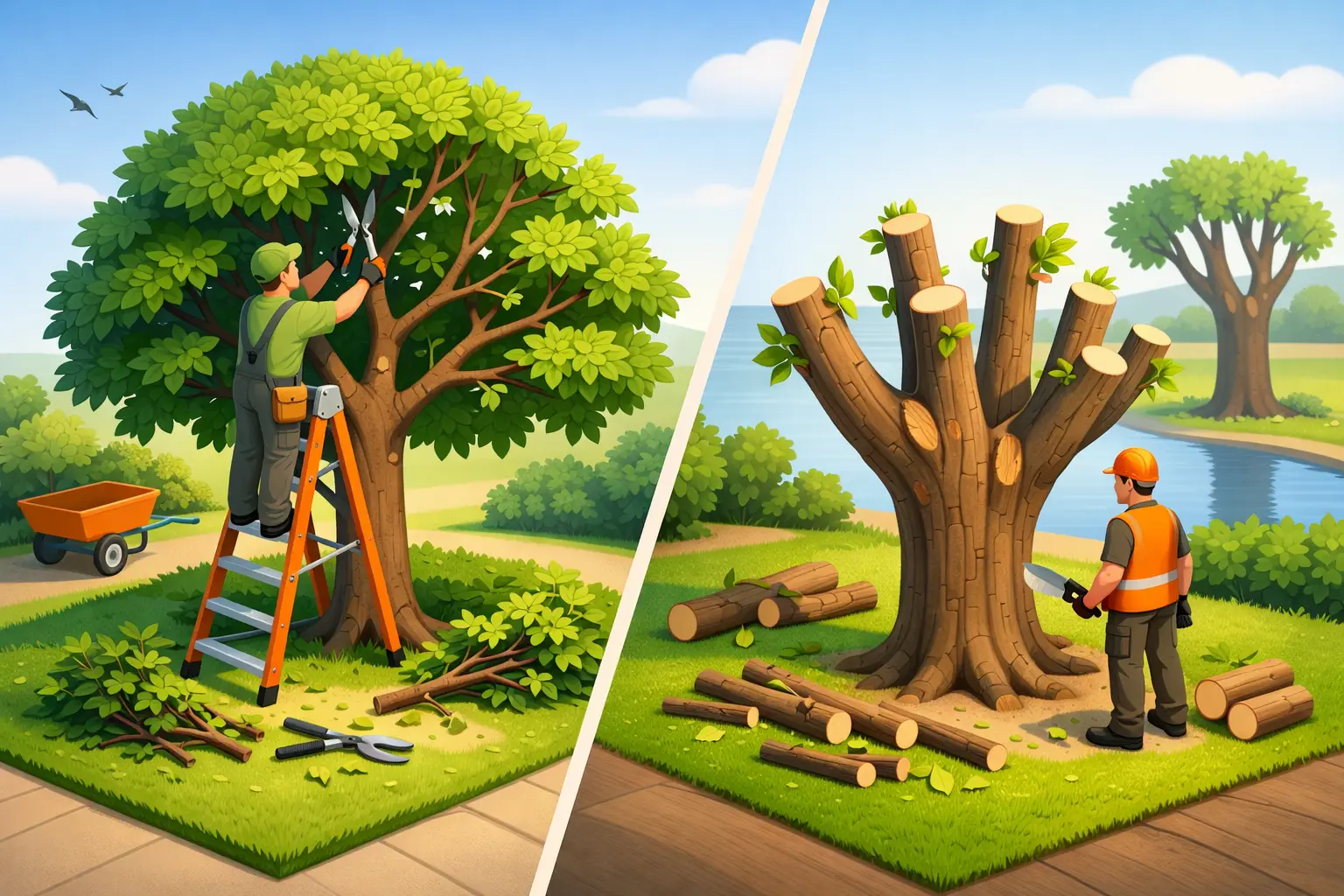
Pruning is the selective removal of branches to improve a tree’s health, shape, clearance, or safety. That might mean taking out deadwood, reducing long overextended limbs, thinning selected branches, or lifting the canopy to create space over a drive, footpath, or garden.
Pollarding is a much more specific and controlled system. It involves cutting back young branches to the same points on a regular cycle, creating a framework of knuckles from which new shoots grow. Rather than shaping the natural crown, pollarding deliberately contains the tree and keeps future growth within a set size.
In simple terms, pruning works with the tree’s existing form. Pollarding manages the tree by repeatedly resetting its upper growth.
That distinction matters. A mature ornamental tree in a garden may benefit from careful pruning to remove defects and keep a balanced canopy. A line of urban street trees, on the other hand, may be pollarded to stop them outgrowing a restricted space. The right approach depends on the species, age, condition, surroundings, and long-term management plan.
When pruning is the better option
Most trees on domestic and commercial sites are pruned, not pollarded. That is because pruning can solve a wide range of issues while preserving the natural appearance of the tree.
A well-planned prune might reduce end weight on heavy lateral limbs, remove crossing branches, clear structures, improve light, or take out storm-damaged sections. Good pruning is measured. The aim is not simply to make the tree smaller, but to make it safer, healthier, and more appropriate for its setting.
This is often the best route for mature trees that have never been managed as pollards. It is also the better option where appearance matters, especially in gardens, estates, shared grounds, and prominent commercial sites. A badly judged reduction can still cause stress, but proper pruning usually gives a more natural result than hard cutting.
There is a trade-off, though. Pruning does not permanently stop a vigorous tree from growing. Some species respond quickly, which means maintenance may still be needed over time. If a tree is fundamentally too large for its position, pruning can manage the issue for a while, but it may not be the perfect long-term answer.
What good pruning should achieve
Professional pruning should have a clear objective before a saw is ever lifted. That could be crown reduction, crown lifting, crown thinning, deadwooding, or removing specific defective limbs. The cuts should be made in the right places, with attention to branch collars, balance, and the overall structure of the canopy.
Random cutting is where problems start. Removing too much at once can trigger stress growth, leave large wounds, and spoil the tree’s shape. Topping, which is often confused with pruning, is not the same thing at all. It usually means cutting back large branches without regard for the tree’s structure, and it often creates weak regrowth and a poor finish.
When pollarding makes sense
Pollarding is not a rescue job for every oversized tree. It is a management system that works best when started early and continued properly.
Certain species tolerate pollarding well, such as lime, willow, plane, poplar and some maples. On the right tree, in the right place, it can be an effective way to maintain size and reduce the risk of branches becoming too large and heavy. This is one reason pollarded trees are common in parks, roadsides, formal avenues, and public spaces where growth needs to be tightly controlled.
For some landowners and property managers, pollarding can also be useful where recurring clearance is needed near roads, boundaries, buildings, or service routes. Once a pollard cycle is established, future maintenance becomes more predictable.
But there are conditions. Pollarding tends to be visually stark just after work is completed. It does not suit every setting, and it does not suit every species. Starting pollarding on an old, stressed, or unsuitable tree can leave it vulnerable to decay and weak regrowth. That is why this method needs proper arboricultural judgement rather than guesswork.
Pollarding needs commitment
One of the biggest misunderstandings about pollarding is that it is a one-off reduction. It is not. Once a tree has been pollarded, it normally needs repeat work on a cycle. If it is left too long, the regrown shoots can become larger and heavier, attached to the old pollard points in ways that may weaken over time.
That means pollarding only makes sense if there is a realistic plan to maintain it. For a homeowner, that may be entirely workable on the right tree. For a commercial site or estate, it can form part of a wider tree management programme. Without follow-up, the benefits are reduced and the risks can increase.
Tree pruning vs pollarding for tree health
Neither method is automatically better for tree health. It depends on what the tree needs and whether the work is appropriate.
Pruning is usually less intrusive when carried out correctly. By removing selected branches rather than repeatedly cutting all new upper growth back to set points, pruning often places less stress on the tree. It can improve airflow, reduce damaged wood, and help the tree develop a stronger structure.
Pollarding can still be a sound option for the right species, especially where it has been established from a younger age. In those cases, the tree adapts to the routine. Problems tend to arise when severe cuts are made on trees that are not suited to the system, or when previous pollards are neglected for years.
Timing matters as well. Different species respond best at different times of year, and some trees are best avoided during periods of heavy sap flow or active nesting season. There may also be legal considerations, especially where trees are protected or located in conservation areas. That is another reason expert advice is worth getting before work begins.
Which looks better?
For most private gardens, pruning gives the more attractive result. It keeps the natural habit of the tree and can make a canopy look lighter, tidier, and better balanced without making it look harshly cut.
Pollarding is more formal and more obvious. Some people like that disciplined appearance, especially on avenues or repeated plantings. Others find it too severe for a domestic setting. Neither view is wrong. It comes down to the tree, the setting, and whether appearance or strict size control is the bigger priority.
If a customer in Fife or the surrounding area asks us whether a tree can be made smaller without looking butchered, that is often where careful pruning becomes the better conversation. If they need a tree kept within a strict size year after year, pollarding may be worth discussing – but only if the tree is suitable and the ongoing management is realistic.
Choosing the right method for your property
The best choice starts with the tree itself. Species, age, vigour, previous pruning history, structural condition, and location all affect what can be done safely. So does the reason for the work. Needing a little more light is not the same as managing a tree beside a building, highway, or busy site.
That is where professional assessment matters. An experienced arborist will look at the crown structure, branch unions, decay, surrounding targets, access, and future growth potential before recommending anything. In some cases, pruning is enough. In others, a managed pollard cycle is the practical answer. And occasionally, neither is the right fix if the tree is unsuitable for the space.
At HL Tree Services, we often find that customers are less concerned with the technical term and more concerned with the outcome. They want the tree safe, healthy where possible, and properly managed without mess or guesswork. That is exactly how it should be approached.
If you are weighing up tree pruning vs pollarding, the safest step is not choosing a method from photos online. It is having the tree assessed properly so the work fits the species, the setting, and the long-term result you actually want. A good tree job should solve a problem now without creating a bigger one later.