A large hedge can make a garden look sharp and well kept – or it can make the whole property feel harder to manage. If you are wondering how to trim large hedges without ending up with uneven sides, damaged growth or a job that runs away from you, the method matters as much as the effort.
Big hedges are not just small hedges on a larger scale. Once height, thickness and access become part of the job, the risks go up and the finish gets harder to control. A neat result depends on timing, the right equipment and a realistic view of what can safely be done from the ground.
Before you trim, check the hedge itself
The first step is to look at the species, the size and the condition of the hedge. Fast-growing conifers, formal privet, mixed boundary hedges and mature beech all respond differently to cutting. Some will recover well from a firm trim. Others do not respond kindly if you cut back into old bare wood.
That matters because a hedge that has been left too long often needs more than a quick tidy. If the sides have become broad and heavy or the top is well above comfortable working height, trying to cut it back in one go can leave gaps, brown patches or a poor shape that is difficult to correct. In some cases, a staged reduction over more than one season is the better option.
It is also worth checking for nesting birds before any work starts. In the UK, active nests are protected, so hedge cutting may need to wait or be adapted. This is one of those areas where rushing a job can create avoidable problems.
How to trim large hedges safely
Safety is the point where many hedge jobs stop being straightforward. If the hedge is tall enough to need ladders, reaches over fences, sits beside a road or has awkward ground beneath it, the work needs more care than most people expect.
For many domestic hedges, the safest approach is to work from the ground with long-reach equipment where possible. Leaning out from a ladder with a hedge cutter is not good practice. It reduces control, limits your footing and makes it much harder to keep the line consistent. Wet ground, slopes and uneven paving only add to the risk.
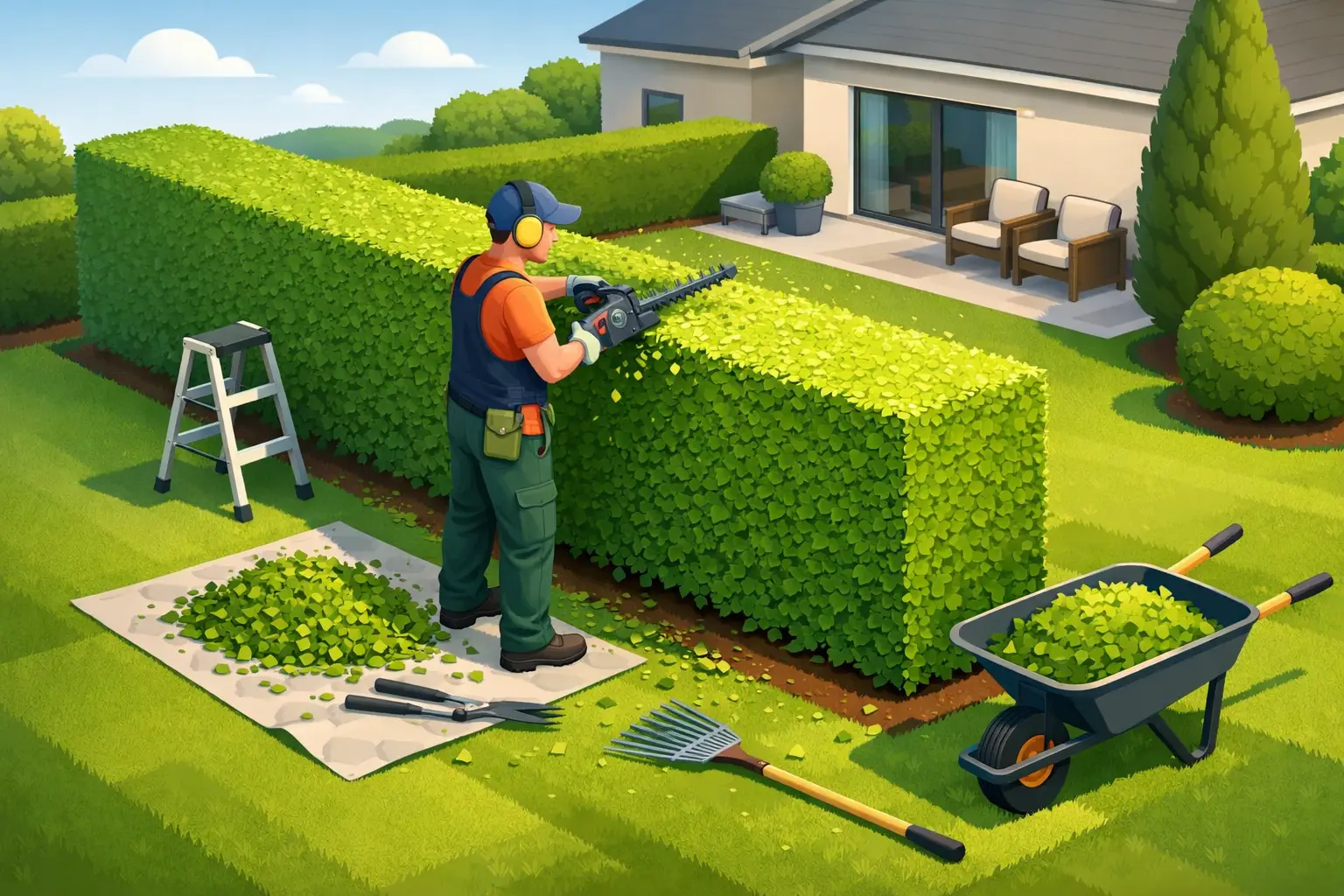
You also need enough space to manage the arisings. Large hedges produce a surprising amount of cut material, and debris left underfoot quickly turns a tidy job into a hazardous one. Good work is not just about the finished shape. It is also about keeping the area controlled and leaving the site clean when the cutting is done.
The best time to cut back large hedges
There is no single answer that suits every hedge, but timing has a big effect on both appearance and plant health. For routine maintenance, many hedges are best trimmed during the growing season when fresh growth can be kept under control. Formal hedges often benefit from one or two cuts a year to hold a crisp outline.
For larger corrective work, it depends on the species and how severe the cut will be. Evergreen conifers, for example, need care because cutting too far back into old wood can leave bare sections that do not fill out again. Deciduous hedges can sometimes tolerate firmer pruning, but even then, the timing should support recovery rather than add stress.
Weather matters too. Trimming during very hot, dry spells can scorch newly exposed growth. Cutting in strong wind or heavy rain is simply poor working practice. A dry, calm day gives a better finish and a safer job.
Getting the shape right
Most large hedges look best and stay healthier when they are slightly narrower at the top than at the base. That gentle taper allows light to reach the lower growth, helping to prevent the bottom from thinning out over time. It is a simple principle, but it makes a real difference.
The mistake many people make is cutting the sides vertically and then flattening the top by eye. On a tall hedge, that often creates a bulky upper section that shades the base and becomes harder to maintain each year. Once a hedge starts to broaden out, every future trim becomes more awkward.
Using string lines or visual markers can help you keep a straight, balanced finish, especially over a long run. On larger boundary hedges, small inconsistencies become obvious very quickly. A careful first pass is better than repeatedly chasing the line and removing too much.
Work in stages, not in one aggressive cut
When trimming a large hedge, take light passes and step back often. This helps you judge the line properly and avoid scalping one section while trying to correct another. Heavy-handed cutting tends to leave a patchy finish and can expose older inner growth that looks brown or sparse.
If the hedge is badly overgrown, it is often better to reduce height or width gradually. That approach may not feel as dramatic on day one, but it usually gives a better long-term result. The aim is not just to make the hedge smaller. The aim is to leave it looking healthy and manageable after the work is complete.
Tools for trimming large hedges
The right tool depends on the hedge height, thickness of growth and access around the site. A standard electric hedge trimmer may be adequate for annual maintenance on a medium hedge, but mature, woody growth often needs more capable equipment.
Long-reach hedge cutters are useful for keeping feet on the ground while working higher sections. Secateurs and loppers still have their place for thicker stems and detail work around awkward corners. For very large or high hedges, specialist access equipment may be the safest and most efficient option.
This is often where the difference between a manageable job and a frustrating one becomes clear. Large hedges can be physically demanding, noisy and messy, and the clean-up can take as long as the cutting. Professional teams use equipment that allows them to work safely, maintain a consistent finish and remove waste properly rather than leaving piles of brash behind.
When a hedge needs more than a trim
Sometimes the question is not really how to trim large hedges, but whether trimming is still enough. A hedge that has become far too tall, too wide for the space or thin at the base may need renovation rather than routine maintenance.
That could mean a phased reduction, selective pruning, or in some cases removal and replacement if the hedge is no longer serving its purpose. This is particularly relevant where light loss, blocked access, neighbour issues or pressure on walls and fences have become ongoing concerns.
There is a trade-off here. A hard reduction can restore control, but it may temporarily leave the hedge looking sparse. A lighter trim keeps it looking green, but it may not solve the underlying problem. Good advice takes both appearance and long-term management into account.
When to call in a professional hedge cutting team
There is nothing wrong with handling straightforward hedge maintenance yourself. But once the hedge is tall, awkward, close to roads or buildings, or simply beyond safe reach from the ground, professional help is the sensible choice.
A trained team can assess the hedge properly, work with the correct equipment and deal with the practical issues that are easy to underestimate – access, stability, traffic awareness, waste removal and keeping the finish even across the full length. If the hedge has not been touched for years, an experienced eye also helps avoid cutting mistakes that are impossible to hide afterwards.
For homeowners and property managers across Fife and the surrounding area, this often comes down to time and risk as much as skill. A large hedge can swallow an entire weekend and still not come out well if the setup is wrong. Getting it cut properly, safely and tidily in one visit is often the better value option.
Keeping large hedges manageable after the main cut
Once a large hedge has been brought back into shape, regular maintenance is what keeps it straightforward. A hedge that is trimmed before it gets out of hand is quicker to cut, easier to keep even and less likely to need severe reduction later.
That routine also helps protect the hedge itself. Repeated light maintenance usually produces denser growth and a cleaner outline than long gaps followed by harsh cutting. It is easier on the plant, and easier on whoever has to manage it.
If you are looking at a mature hedge and wondering whether it needs a light trim, a proper reduction or a safer professional approach, the honest answer is that it depends on height, species, access and condition. The important thing is not to force a risky job or guess your way through a cut that will shape the hedge for years to come. A well-trimmed hedge should look tidy, stay healthy and make the property easier to manage – not leave you with a bigger problem than you started with.