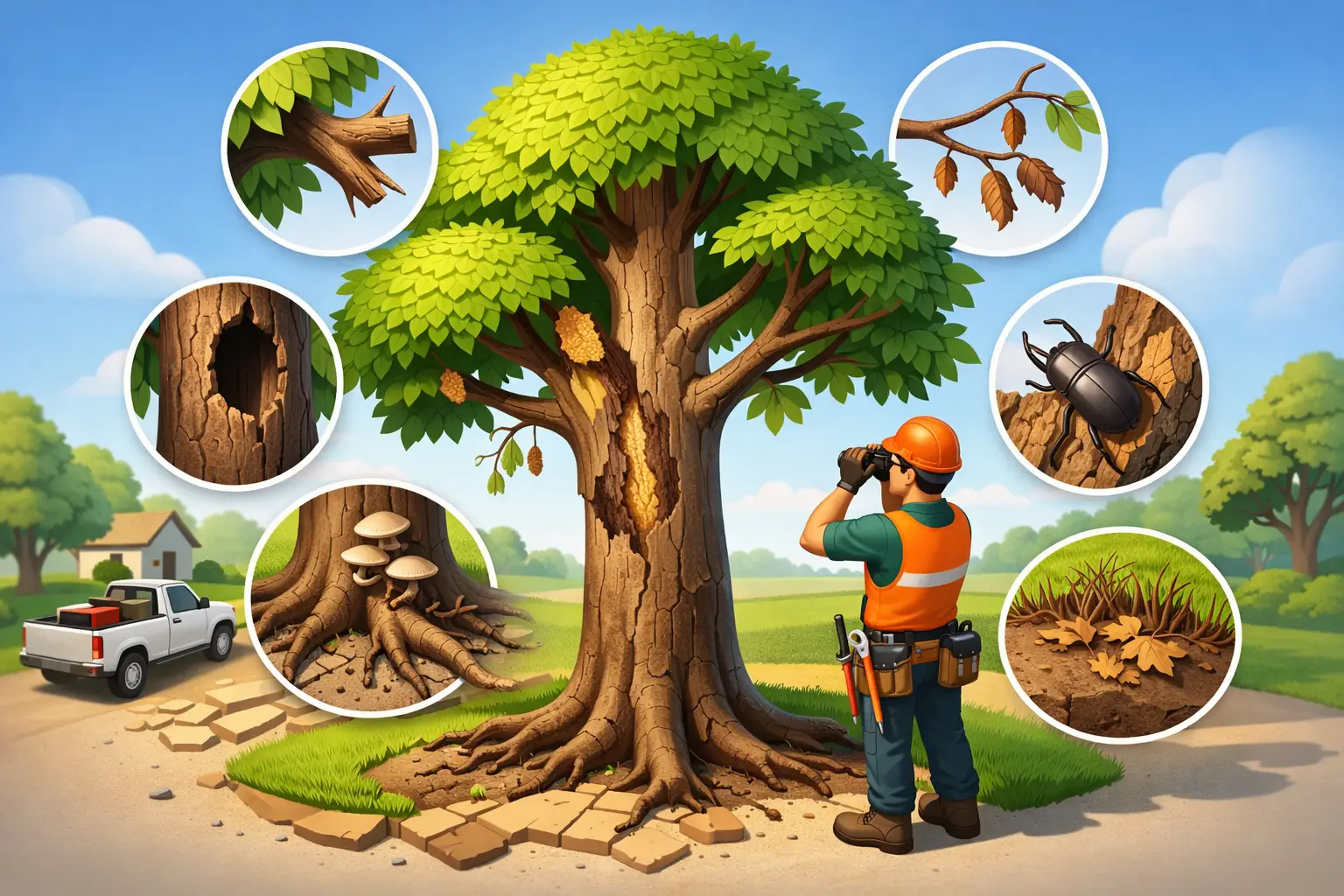
A mature tree can look perfectly healthy from the kitchen window while a crack, cavity or failing root system is developing where it cannot be seen. That is why a proper guide to tree risk assessments starts with one clear principle: risk is not judged by appearance alone. It is judged by the condition of the tree, the likelihood of failure and what could be harmed if it does fail.
For homeowners, estates and commercial sites, a tree risk assessment provides practical answers. Is the tree safe to retain? Does it need pruning, monitoring or more detailed inspection? Or does the risk justify urgent work? The aim is not to remove every ageing or imperfect tree. It is to manage genuine hazards sensibly while preserving healthy trees wherever possible.
What Is a Tree Risk Assessment?
A tree risk assessment is a structured inspection by a competent arborist to identify defects and assess whether they could cause harm. The inspection considers the whole tree: roots, stem, branches, crown condition and its surroundings.
A tree does not need to be dead to pose a risk. Likewise, a tree with a hollow stem or some deadwood is not automatically dangerous. Trees can tolerate defects remarkably well, particularly where there is little chance of a person, vehicle or building being affected. Context matters as much as the defect itself.
An arborist will usually consider three linked questions: what might fail, how likely is failure, and what is the potential target beneath or beside the tree? A large decayed limb over a busy driveway needs a different response from the same limb over an unused corner of a field.
When Should You Arrange a Tree Risk Assessment?
Regular assessment is sensible for mature trees near homes, footpaths, roads, car parks, play areas and public access routes. It is also worthwhile before buying or developing a site, after major groundworks, or where trees form part of an estate or commercial property maintenance plan.
Storms are an obvious trigger, but they are not the only one. Prolonged wet weather can soften ground around roots, while drought can stress trees and contribute to branch dieback. Construction activity, changes in drainage, trenching and soil compaction may all affect a tree long after the contractors have left site.
Arrange an inspection promptly if you notice a new lean, lifting soil around the base, fresh cracks, large dead branches, fungal growth near roots, cavities, or repeated limb failure. These signs do not prove that a tree will fail, but they should not be ignored – particularly where people or property are within reach.
For an immediate threat, such as a hanging branch over an entrance or a storm-damaged tree resting on another tree, keep people away from the area and seek professional emergency assistance. Do not attempt to pull down branches, climb the tree or cut timber under tension.
A Guide to Tree Risk Assessments: What an Arborist Looks For
A professional assessment begins with the site. The arborist will establish how the area is used and whether there are targets such as houses, sheds, overhead lines, roads, parked cars or frequent pedestrian routes. A tree beside a quiet garden boundary may require monitoring; the same tree above a school entrance may need action without delay.
Root and ground condition
Many serious failures begin below ground. The assessor will look for disturbed soil, heaving, root damage, decay fungi, poor drainage and evidence that recent excavation or building work has affected the rooting area. A sudden lean is particularly concerning, especially if the ground has cracked or lifted on one side of the tree.
Root problems can be difficult to confirm from a visual inspection alone. Where the findings are unclear, a more detailed assessment may be recommended rather than making assumptions or carrying out unnecessary work.
Stem defects and decay
Cracks, seams, cavities, old wounds and areas of decay can reduce a stem’s strength. Their significance depends on size, position, depth and the species of tree. Some trees can adapt around old damage; others may have a reduced safety margin, particularly where the defect is at the base or where multiple stems join.
Fungal fruiting bodies are also recorded. They can indicate decay within roots or timber, although the type of fungus and the tree’s overall condition must be assessed carefully. Removing the visible fungus does not remove the underlying issue.
Branches and crown condition
The crown can reveal stress through deadwood, thinning foliage, broken limbs, weak unions, unbalanced growth or dieback. Included bark, where two stems have grown tightly together without a strong joining structure, is a common weakness in multi-stemmed trees.
An assessor will look at branch size, loading and direction of growth, rather than simply recommending a reduction because a tree is tall. Height alone is not a defect. Poorly planned cutting can create larger wounds, encourage weak regrowth and leave the tree in worse condition over time.
How Risk Is Managed After the Inspection
The recommendation should match the level of risk, not follow a one-size-fits-all approach. In some cases, no immediate work is needed beyond recording the tree’s condition and reviewing it at a suitable interval. Monitoring is often the right option where a defect is present but the target is limited or there is no clear sign of progression.
Where work is required, it may involve removing deadwood, reducing the end weight of an overextended limb, removing a compromised branch, improving clearance from a building, or felling a tree that cannot be retained safely. The least intrusive effective option is generally preferable.
It is worth being cautious with requests to heavily top or lop a tree. Severe pruning may appear to offer a quick fix, but it can stress the tree and lead to dense, poorly attached regrowth. A qualified arborist should explain what the proposed work will achieve, what it cannot achieve, and how it may affect the tree’s future condition.
For awkward trees over roofs, narrow access routes or busy areas, specialist equipment and careful planning make a significant difference. Controlled dismantling, rigging and, where access allows, a cherry picker can help complete work safely while protecting gardens, buildings and neighbouring property.
Visual Inspections and Detailed Investigations
Not every tree needs an advanced investigation. A ground-based visual inspection is often enough to identify obvious defects and recommend proportionate action. It is efficient and suitable for many domestic trees, routine site checks and post-storm assessments.
However, a visual inspection has limits. Dense ivy can conceal defects, decay can be hidden inside apparently sound timber, and root conditions cannot always be judged from the surface. If the risk cannot be properly evaluated, an arborist may recommend climbing inspection, aerial assessment or specialist diagnostic testing.
This is not needless complication. More detailed work is most useful when the tree has high value, the potential consequences of failure are significant, or removal would be costly or undesirable. It can provide the evidence needed to retain a valuable tree with confidence, or to justify necessary work.
Records, Responsibilities and Legal Checks
For commercial properties, estates and managed sites, keeping records matters. A written inspection record shows that trees have been considered as part of normal site management and helps prioritise works across a larger portfolio. It should identify the tree or area inspected, observations made, recommended actions and review timescales.
Homeowners also benefit from clear written advice, particularly where a tree is close to a boundary, a neighbour’s property or a public path. If work is recommended, check whether the tree is protected by a Tree Preservation Order or located within a conservation area before arranging pruning or felling. Permission may be required, and the process should be dealt with before work begins except in a genuine emergency.
Tree ownership can also be less straightforward than it first appears. A boundary line on a plan, historic planting, shared access and overhanging branches can all create uncertainty. An assessment identifies the tree condition, but ownership and legal responsibility may need separate clarification.
What You Can Check Between Professional Visits
Property owners are often the first to notice change. A simple seasonal walk-round is useful, especially after strong winds. Look from a safe distance for fresh damage, unusually large dead branches, a changed lean, cracks in the main stem, mushrooms around the base and soil movement near roots.
Avoid probing cavities, removing bark, cutting roots or climbing to inspect a concern yourself. These actions can cause damage and may place you directly in the danger zone. Take clear photographs from the ground, note when the change was first noticed, and keep people away if there is an obvious hazard.
A good assessment is not about treating every tree as a problem. It is about making informed decisions before a minor concern becomes an emergency. For trees across Fife and the surrounding area, HL Tree Services can provide practical, honest advice and carry out the recommended work with safety, care and a tidy finish. The best time to assess a worrying tree is while there is still time to choose the right solution.